

Workspaces play a big role in employee productivity, client impressions, and overall brand identity. But over time, offices need upgrades, whether small improvements or complete transformations. That’s where the choice comes in: renovation or redesign. Many business owners struggle to decide which option makes more sense. This guide breaks it down with clear differences, practical tips, and a checklist to help you make the right decision.
What’s the Difference Between Renovation & Redesign?
Though the terms are often used interchangeably, renovation and redesign are not the same. Each serves a different purpose depending on your office needs.
Renovation
Renovation focuses on improving the condition and functionality of an existing space. It often involves structural and functional upgrades such as repairing or replacing outdated elements, updating plumbing and electrical systems, or even partial demolition. Renovation makes a space more usable and up-to-date while maintaining its original framework.
Example: Modernizing office infrastructure, constructing an extension, or removing old fixtures are all examples of ways to increase the space’s usability.
Redesign
Redesign emphasizes improving the aesthetics, layout, and user experience of a space without major structural changes. It includes cosmetic and functional updates that align the office with brand identity, culture, and employee needs. This may involve new paint schemes, updated furniture, or reconfigured layouts to improve workflow and collaboration.
Example: Repainting walls, rearranging desks, or introducing new furniture to create a fresh and more engaging work environment.
When is Renovation the Better Choice?
If you want to make some improvements to your office that is already in good shape, but you don’t have a lot of time or money, or if you want a completely custom-made building, are fixing serious damage that already exists, or need to make major changes to the designs or construction of your building, this is not the way to go.
- If the building’s structure and main elements are in good form, refurbishment is a good way to refresh it without spending a lot of money.
- Renovating an office, especially for smaller, more specific jobs, can often be cheaper than buying a new one or building one from scratch.
- You can save time and work by only fixing up the parts of your office that really require repair, such as the bathrooms, cabinets, or electrical systems.
- In other words, renovations are a good fit for projects with tight deadlines because they usually take less time than developing something new.
- Remodelling can help you improve your property while keeping its distinct historical character, sentimental value, or original style.
- Fixing a leaking roof or a wall that has been damaged can fix an issue right now and stop more expensive damage from happening in the future.
When Should You Opt for a Full Redesign?
A full redesign is the best choice when you want to make significant improvements that go beyond cosmetic updates. If you’re looking to redefine your brand, adapt to business growth, or implement new work methods, this all-encompassing approach is perfect for you.
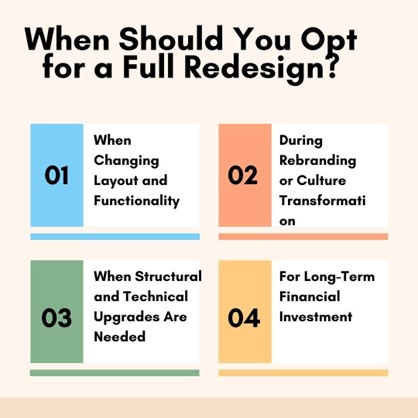
- When Changing Layout and Functionality
If your team has outgrown the current layout and tiny changes won’t work anymore, it’s time for a full overhaul. If you want to switch to a hybrid or flexible work style that needs spaces that are either quiet and focused or open and collaborative, you’ll need to completely rebuild the space. A complete redesign ensures your layout supports productivity by strategically repositioning desks, meeting rooms, and common areas.
- During Rebranding or Culture Transformation
If your company is changing its name or going in a different direction, a comprehensive design can assist your workplace in incorporating your new brand identity by showing your new values and purpose. A full makeover lets you make the space you want, whether you want it to be more relaxed, creative, or collaborative. A modern, well-designed office lets current and potential employees know that you care about their health and pleasure at work.
- When Structural and Technical Upgrades Are Needed
Smart lighting systems and powerful video conferencing are examples of modern workplace technology that may be easily added to a complete design. If you’re not using your space to its full potential, a careful look at your design and space planning will help you find methods to make the most of what you have. A full design is needed for any substantial structural changes, such as tearing down walls, combining office units, or changing the plumbing and electrical systems.
Read More: Transform Your Workspace: 10 Key Aspects of Contemporary Office Design
- For Long-Term Financial Investment
Putting money into a decent design is like making a smart investment that will pay off over time. It can make your home worth more and work better, which means you’ll get a decent return on your money. Even though they cost more up front, major renovations may save you money in the long term compared to making small improvements over and over again. You won’t be able to get a full, high-quality solution if you try to do everything on your own. The best way to go is with a full-service design approach and oversight from a contractor.
Cost Comparison: Renovation vs Redesign
| Aspect | Renovation | Redesign |
| Average Cost | Lower | Higher |
| Time to Complete | Short | Longer |
| Level of Disruption | Low | Moderate to High |
| Scope of Work | Repairs & small Changes | Layout, Structure & Decor Changes |
How to Decide: A Quick Assessment Checklist
- Does your office need minor fixes, or does the space require a complete transformation?
- Is the current layout outdated compared to your brand and decor?
- Do you have a small or a large budget?
- Are you aiming for long-term, sustainable changes or short-term improvements?
- What is your primary goal? Is it to make things look better or to get staff to work together more?
If most people think just small improvements are needed, it’s time to decide to renovate.
If you want significant changes, a full redesign is the best approach.
Renovation vs. Redesign: Key Difference
| Renovation | Redesign | |
| Goal | To repair, restore, or upgrade an existing office space to make it safer, more functional, and up to modern standards. | To reimagine the look, feel, and functionality of the office space, often aligned with new branding, culture, or workstyles. |
| Scope | Involves fixing structural issues, updating systems (plumbing, electrical, HVAC), and replacing outdated or damaged elements.useful or broken. | Focuses on altering the office layout, interiors, and aesthetics without major structural changes. |
| Example | Upgrading lighting, fixing flooring, replacing ceilings, repairing walls, or modernizing electrical systems. | Rearranging workstations, introducing new furniture, repainting, adding collaborative zones, or refreshing brand aesthetics. |
| Cost | Typically less expensive than redesign since it targets repairs and updates without changing the overall concept. | Usually more costly as it involves conceptual changes, new layouts, and aesthetic upgrades across the workspace. |
| Outcome | A safer, more efficient, and refreshed office that continues its existing function with improved infrastructure. | A transformed office environment with a new identity, improved aesthetics, and optimized workflow. |
Also Read: Cost-Effective Office Renovations: How to Refresh Your Workspace on a Budget
Conclusion
When determining whether to remodel or renovate your office, you should think about your own goals, your budget, and your schedule. At Arteriors, our expert office interior designers help businesses transform workspaces through both renovation and redesign. Contact us today to create a workplace that boosts productivity and reflects your brand identity. We are skilled and help your businesses and turn your buildings into workplaces that are both productive and motivating.

Share your thoughts
No Comments